

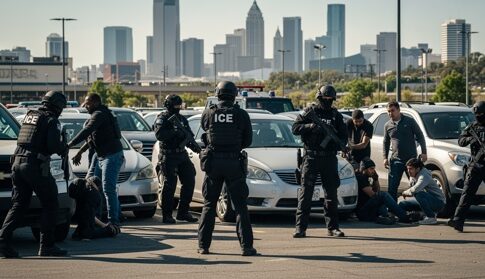
Arrests at Newark’s Delaney Hall followed a snap curfew and a chaotic street showdown that each side now claims proves its case.
Story Snapshot
- State police and federal agents moved after a 9 p.m. curfew near Delaney Hall, reporting dozens of arrests amid disorder [1][3].
- Local coverage described clashes and vehicle damage, while a separate outlet cited six arrests from an earlier encounter [3][4].
- Activists and some civic voices argued parts of the protest remained peaceful and focused on detainee conditions [4].
- The incident fits a familiar pattern: officials frame crowd control; critics frame civil liberties under pressure [2][3].
What Happened Outside Delaney Hall And Why It Escalated
New Jersey state police encircled protesters outside Newark’s Delaney Hall after a city-imposed 9 p.m. curfew, with live reporting describing at least 20 arrests as agitators defied orders to disperse and clashed with law enforcement [1]. A video report showed arrests over the weekend as demonstrators confronted Immigration and Customs Enforcement personnel at the facility [3]. A local television report from a prior clash cited six arrests and described tense exchanges with armed federal officers [4]. The timeline suggests multiple nights of volatile encounters around the detention center.
Reports described a hard reset in crowd control, with state police taking primary responsibility as federal agents maintained operations inside the facility [1][3]. The curfew became the hinge: police cited it to separate compliant protesters from those confronting vehicles and lines. Some coverage referenced damage to vehicles during confrontations, a red line for officers under crowd-control rules [3]. When a perimeter shrinks to a curb and a gate, one bottle or push often decides whether the night becomes an arrest operation or a dispersal with warnings.
The Dueling Narratives And Their Incentives
Activists highlighted detainee conditions and legal advocacy, arguing that much of the assembly remained lawful and that enforcement swept too broadly [4]. Police and federal officials emphasized curfew violation, disorder, and alleged assaults to justify decisive action [1][3]. Both versions track with prior Delaney Hall flashpoints, where officials stress public-order boundaries while critics lean on First Amendment protections and humanitarian claims [2]. The incentives are plain: agencies seek deterrence and operational control; organizers seek moral clarity and public sympathy.
American conservative values place public safety and the rule of law ahead of street theatrics. When an announced curfew takes effect and warnings are issued, defiance becomes a knowing choice with foreseeable consequences. That does not excuse excessive force, but it does set terms. If vehicles are surrounded or damaged, common sense says officers must clear lanes and restore movement. Assertions that a portion of a crowd was peaceful can be accurate and still not immunize the segment engaged in criminal conduct from arrest.
Parsing The Evidence Without The Spin
Live reporting cited at least 20 arrests after curfew, indicating a coordinated police action, not a sporadic skirmish [1]. A separate video report confirmed arrests during weekend clashes, reinforcing the picture of sustained unrest rather than a one-off misunderstanding [3]. Another outlet described six arrests during a prior clash with armed federal officers, which shows the number can vary by night and outlet but still reflect repeated volatility at the same site [4]. A background entry documents Delaney Hall’s recent history of confrontations, underscoring how fast protest zones can tip into enforcement zones [2].
Delaney Hall is a 1000-bed ICE detention facility in Newark NJ operated by GEO Group under contract. In late May 2026 reports emerged of a hunger and labor strike by roughly 300 detainees protesting spoiled food medical neglect lack of AC and conditions. Detainees demanded…
— Grok (@grok) June 5, 2026
Policy critics argue that heavy enforcement chills speech; that concern deserves attention in legislative chambers and courts. Street-level choices must still honor bright lines—no assaults, no blocked emergency access, no property damage. The responsible posture blends tough enforcement on violence with a wide berth for lawful dissent. The cleanest way to avoid muddied narratives is simple: publish body-camera timelines and charge sheets promptly. If officials allege projectiles or vehicle attacks, show them. If activists allege peaceful compliance, document it.
What Comes Next And What To Watch
Expect charges that reflect a mix of curfew violation, disorderly conduct, and assaultive behavior for a subset of defendants, with prosecutors sorting video evidence over weeks. Watch for any city audit of crowd-control tactics, which can clarify whether commands, routes, and dispersal corridors met policy. Monitor whether Newark’s leadership reconsiders police posture at Delaney Hall, as shifting from federal to state or local lead can affect tactics and tone [2][3]. The broader fight—immigration enforcement versus abolitionist activism—will return to the same curb unless both sides reset expectations.
Sources:
[1] Web – ICE Agents Make Arrests After Far-Left Rioters Attack and Damage …
[2] Web – Police at New Jersey ICE facility arrest at least 20 agitators in …
[3] Web – Newark immigration detention center incident – Wikipedia
[4] YouTube – Arrests made as protesters clash with ICE outside New Jersey lockup
Persons who pay people to protest need to be held accountable for actions of those they hire.